Showing posts with label Orignal Wine Crates and Boxes. Show all posts

Wednesday, January 27, 2016

Chateauneuf Du Pape Beaucastel

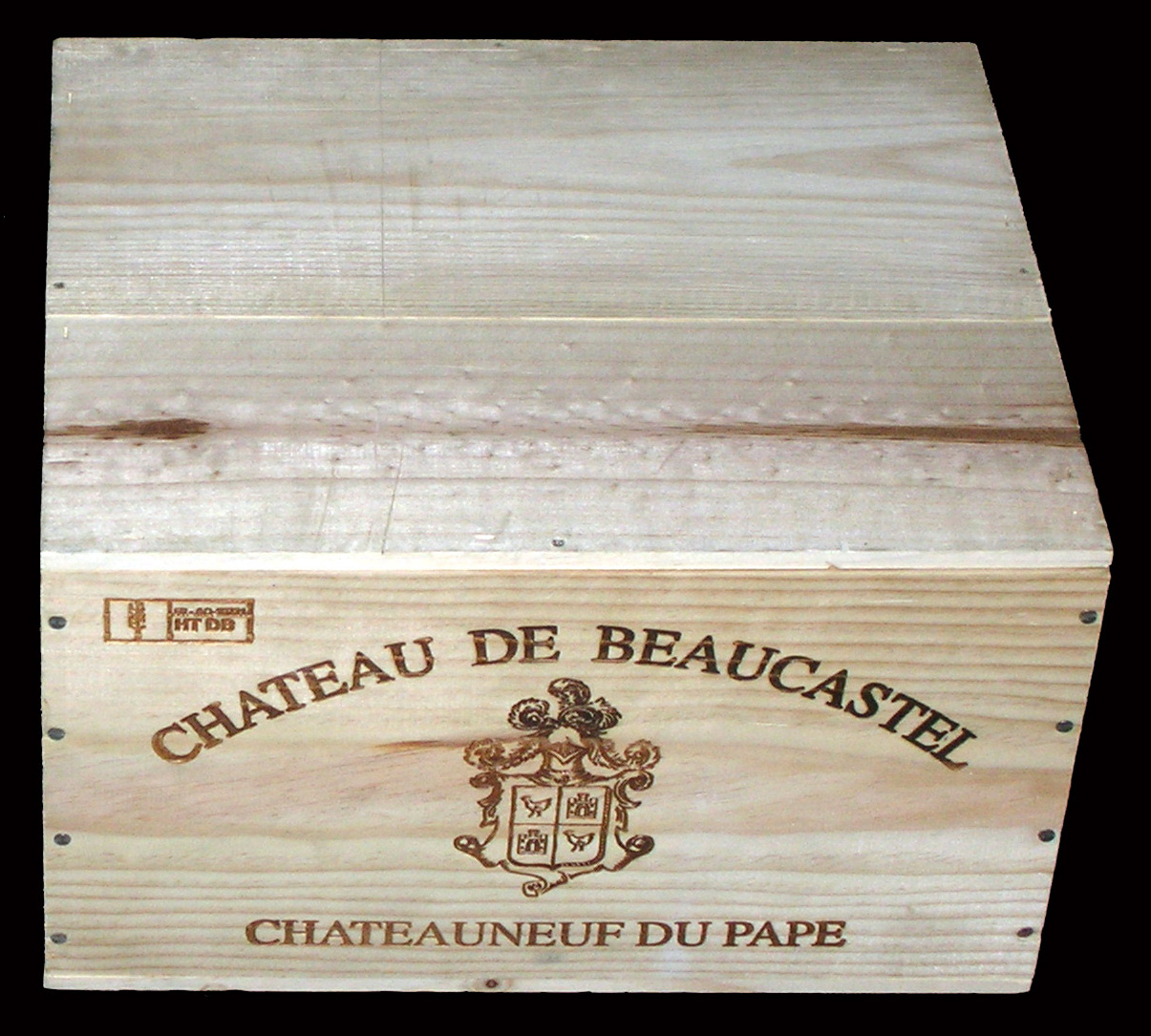
Chateauneuf Du Pape Beaucastel Wooden Wine Box


Beaucastel brings back fond memories. It was the first wine box we sold when Winepine started 11 years ago. The beautifully decorated cote of arms design always takes me back to that time.

Chateaneuf Du Pape Beaucastel is among the most revered vineyard in all of Rhone. Not much has changed throughout the near millennia since it's land has been producing wine in modern France. Although the Beaucastel name wasn't truly established until the 14th century, it's quite likely that it's land was producing wine well before the 1st century. When you look at this wine box your looking at a tiny piece of recorded history.

Many of the ancient vines were destroyed by Phylloxera in the 19th century, but since the replanting a few decades later the vines were restored to their former glory. I purchased a few bottles of 2007 for a Thanksgiving party and they were finished in the blink of an eye. Although it would've been nice to experience wine from vines dating back hundreds of years, I can't imagine the legendary Beaucastel quality to be that much more significant during any period of time.
Country: France

Region: Rhone

Sub-Region: Chateauneuf Du Pape

Established: 1321

Production: 8,000 cases averaged among 5 different single vineyard plots

Grape: Makes both Rhone grape varietal reds and whites

Box design: Historic Beaucastel Cote of Arms engraved on the front side

Rarity: Fairly. Some vintages are made without wooden wine boxes

Crate designation: Collector's ($35.00)

Our opinion/history: Chateauneuf means "New Castle of the Popes" and Beaucastel was the first Rhone vineyard in which the Vatican acquired to make Sacramental wine. There's a deep and rich history of this vineyard that dates back 1,000 years or more, and most of the wines from the region pair well with hearty meats.


Follow us for special updates!


Wednesday, June 27, 2012

5 DIY Projects with Wooden Wine Crates and Wine Boxes

Wooden wine crates and wine boxes are a very unique way to enhance your decor. They're durable, versatile and classy. Below are 5 things you can do with them:


  • Create a garden


How to make it:

http://remodelista.com/posts/diy-small-space-vegetable-garden


  • Beautiful and easy wall displays


How to do it:

http://www.apartmenttherapy.com/a-display-shelf-made-from-a-wi-122136


  • Wine Crate Bookshelf


How to assemble:


  • White washed wine window box

How to do it:


  • Age the crate to a "shabby-chic" look


Before


After


How it's done:


Patrick


Monday, June 18, 2012

How many wine panels do I need to cover my wall?

How to determine square footage for a wine crate panel wall

We frequently get asked "how many wine panels are needed to cover my wall?"

Below is how to determine the square footage of the wall, and how large the wine crate panels are:

The Wall

The first thing to determine is the square footage of the wall. The square footage is found by multiplying the length of the wall by the height of the wall.

For instance; the below picture from left to right (length) is 12 feet across


The top to bottom (height) from the floor up to the ceiling is 8 feet

12 feet X 8 feet = 96 square feet

The wall is 96 square feet.


The Panels


The above panel is the same size and style of the panels on the Grapes wall, which are:

12" L (left to right) X 6" H (top to bottom).


This means that each panel can cover 1 foot left to right and a half foot top to bottom. If you were to place one panel on top of another on the wall, you would get one square foot of coverage space.


Two Wine crate panels covers one square foot.


The grapes wall is a bit complex because of the windows, but if you remove the windows from the wall you would have 16 rows (top to bottom) of 12 panels across (left to right). 


12 X 16 = 192


Without the windows you'd need 192 panels to cover a 96 square foot wall.


Wine crate panels are very easy to trim, cut and finish. We did a bit of this to make the panels flow around the Grapes windows. You may have some corners to work through like the picture below:


This is the Ritz Carlton Penthouse wine cellar in Dallas. Some of the panels were placed vertically to enhance the look. The project was done by architects, interior decorators and contractors working together, so this type of design is more suited for highly skilled professionals.


Feel free to visit us at www.winepine.com for pictures, details and questions on how to create your own unique wine panel project!

Visit us at: www.winepine.com

A special thank you to:

@anntran_

@cammipham

@grapestwc

@problogger

Your relentless work in the pursuit of something better inspires me.

Saturday, December 10, 2011

What are Wine Crate Inserts?

We're often asked by first time clients: What are inserts?

Inserts cradle the bottles inside the box or crate. They come in either wood or cardboard. The wooden inserts slide into the inside of the crate. Below is a picture of wooden inserts for a wine crate:

6 bottle crate wooden inserts


The above picture is the inside of a 6 bottle crate with two inserts. The top and bottom inserts slide into the crate because the crate has routed grooves as shoown above. The 4 routed grooves allow the inserts to slide in and out.

When adding 6 bottles to the above crate, you would remove both inserts and place three bottles at the base/bottom of the crate. You would then place the inserts over the three bottles, and then place the remaining three bottles on top of the inserts. All will fir perfectly, and wont move in transit.

Cardboard inserts are a little different, and they're generally used for crates without these routed grooves. The cardboard inserts are crafted in the shape of a wine bottle. Below is a picture of two 6 bottle wine crates with cardboard inserts:

Two 6 bottle crates with cardboard inserts:


Cardboard inserts are both stackable and removable. Each crate above has two sets of the inserts. Not one. There is a top insert and a bottom insert. They are stacked together.

When adding 6 bottles to each of these crates, you would remove the top inserts and place three bottles into each of the bottom inserts. Cardboard inserts are in the shape of bottles so they will all fit snugly.

Once the three bottles are in each crate, you would place the top insert above the bottles and add the remaining bottles to the top insert. The top inserts keep the bottles from touching each other. The inserts act as "pillows" inside the crate.

There are also 12 bottle crates that have cardboard inserts as well:


As you may see, there are two different sizes on the cardboard inserts. This is because the left hand crate is from Bordeaux, and the right hand crate is from Burgundy. The wineries in Bordeaux and in Burgundy often make differently sized bottles.


Below is a picture of a crate with wooden inserts that have been individually wrapped (left), one with cardboard inserts (middle), and one with no inserts (right)

The inside of three 12 bottle crates 


The final picture is a flat crate with the inserts inside the crate:

Winter 6 bottle flat crate


This is a flat crate that stores the bottles across from left to right. They aren't stacked like the other ones above.

The inserts in the Winter crate are in 4 different pieces: The top 2 inserts (where the lid is) are both removable as is the bottom 2 inserts (just above the winer logo) and they're both removable as well. There are a total of 4 pieces here, not two. It looks like the inserts are each one piece but they're not.

How you'd add the bottles: Remove the top parts of both inserts and place the bottles on the bottom insert. You would then put the top inserts back above the bottles to secure them in place.

Now the bottles are fully protected in the crate and won't move in transit. Close the lid and they're good to go!


Sunday, October 2, 2011

Napa Wooden Wine Box Pictures (Exclusive Class)

Exclusive Class Wine Box & Crate Pictures

Below are assorted wine boxes and crates from Napa Valley.


Bond 6 Bottle Flat (Slide-Top Lid)


Groth 6 Bottle (Flip-Top Lid)


Harlan Estate 3 Bottle Flat (Slide-Top Lid)


Hundred Acre 3 Bottle Flat (Flip-Top Lid)


Rare Screaming Eagle Double Magnum (Slide-Top Lid)


Rare Silver Oak Double Magnum (Slide-Top Lid)


Sin Que Non "Eleven Confessions" (Standard Lid)


Winter 6 Bottle Flat (Flip-Top Lid)


Axios 6 Bottle (Flip-Top Lid)


Rare Chaleur Estates 12 Bottle (Standard Lid)


Cakebread Cellars 6 Bottle (Slide-Top Lid)


Far Niente 12 Bottle (Standard Lid)


Mount Veeder 6 Bottle (Flip-Top Lid)


Maya 3 Bottle (Flip-Top Lid)

Visit Winepine at: www.winepine.com


Monday, September 5, 2011

Wood Wine Crate & Box Profiles: Chateau Lafite Rothschild

Chateau Lafite Rothschild


Country: France

Region: Bordeaux

Sub-region: Pauillac

Classification: First Growth

Production: Approx. 20,000 cases per year

Grape: Mostly Cabernet Sauvignon. The varietal percentages change a bit from vintage to vintage.

Crate design: Chateau Lafite Rothschild has the largest case production of all of the First Growth's; so it's not uncommon to acquire a 6 bottle crate, single bottle crate or 3 double-magnum crate when purchasing at private auction. The most common crate size still remains the 12 bottle size. The Lafite Rothschild logo and artwork is highly recognizable, and many wineries near Pauillac often mimic it on their crates.

Rarity: Very rare. Although many Lafite crates are produced every year, wealthy collector's and wine investors almost always store their original Lafite Rothschild wines in the original crate.

Crate designation: Exclusive Class First Growth ($100.00)

Our opinion: Chateaue Lafite Rothschild is known as the "King's Winery", and is considered the most regal First Growth. Lafite Rotshchild has been linked to wealth and high society for nearly a thousand years. Even today, the wealthiest men in the world seem to enjoy Lafite Rothschild more than any other wine.

Case in point: The Russian billionaire: Mikhail Prokhorov, had invited 60 minutes to his lavish home for dinner. The only wine served during all 7 courses was a variety of different vintage Chateau Lafite Rothschild.

Visit us at: www.winepine.com

Sunday, September 4, 2011

Wood Wine Crate & Box Profiles: Chateau Haut-Brion

Chateau Haut-Brion:


Country: France

Region: Bordeaux

Sub-region: Pessac-Leognan

Classification: First Growth

Production: 9,000 - 14,000 cases per year

Grape: 90% Merlot and Cabernet Sauvignon, with a 10% split between Cabernet Franc and Petit Verdot

Crate design: Haut-Brion has the most unique sized crate of all the Bordeaux wineries. It's very thick and chunky piece, similar to a 6 bottle flat but about twice the height. The inserts of an Haut-Brion crate are very attractive and can be removed very easily. Chateau Haut-Brion has the most simple design logo of the growths but it's highly recognized.

Rarity: Extremely rare. Haut-Brion produces the lowest amount of crates amongst the 1st Growths.

Crate designation: Exclusive Class First Growth ($100.00)

Our opinion: The Pessac Leognan region traces land cultivation for wine back to before Jesus Christ. Once the Roman Empire established a vineyard on what's known as Chateau Haut-Brion, they realized there had been grape cultivation for wine centuries before.

Although Haut-Brion has a great deal of historical significance, it's had a great many problems with it's various owners. Chateau Haut-Brion is owned by the Clarence Dillon Family Corporation, and it was purchased by the American buisnessman Clarence Dillon in 1935. It's one of the few Bordeaux wineries owned by an American.

Visit us at: www.winepine.com

Friday, September 2, 2011

Wood Wine Crate & Box Profiles: Chateau Latour

Chateau Latour:


*A very rare Chateau Latour 3 bottle crate


Country: France

Region: Bordeaux

Sub-region: Pauillac

Classification: First Growth

Production: 16,000 - 20,000 cases per year

Grape: 75% Cabernet Sauvignon, 20% Merlot and 5% Cabernet Franc and Petit Verdot

Crate design: Chateau Latour has the very ancient logo of the "Lionness of France" standing above Fort Castillon.

Rarity: Extremely rare. We have a great difficulty acquiring Latour crates. Although Latour produces the most cases amongst the other 4 First Growth's, they are the most sought after by major wine investors and collector's.

Crate designation: Exclusive Class First Growth ($100.00)

Our opinion: Chateau Latour has the most well-known historical story of all the First Growth's. The Latour logo is based on the legend of St. Joan of Arc. During the Hundred Year War between France and Britain, the Castillon fort was the last bastion of France's defense force. Joan of Arc stood atop the Castillon fort with her battlecry, and was able to break the lines of the British singlehandedly. This is how she became known as the "Lioness of France".

Visit us at: www.winepine.com

Monday, August 22, 2011

Wood Wine Crate & Box Profiles: Chateau Margaux

Chateau Margaux:

*Chateau Margaux and Second Label; Pavillon Blanc

Country: France

Region: Bordeaux

Sub-region: Margaux

Classification: First Growth

Production: 10,000 - 12,000 cases per year

Grape: 75% Cabernet Sauvignon,  20% Merlot and 5% Cabernet Franc and Petit Verdot

Crate design: The Margaux design is based on the majestic and famous Chateau built by Marquis De Colonilla in the early 1800's.

Rarity: Very rare. Approx. 12,000 cases of Margaux are produced per vintage. Most of these cases are held in France, and the remaining amount are fought over in the futures market or at auction. Margaux is widely considered as possibly the finest in all of the First Growths.

Crate designation: Exclusive Class First Growth ($100.00)

Our opinion: Chateau Margaux is definitely the most consistent of the First Growth wineries as far as production goes. You can be fairly confident that any bottle from any vintage year is going to be out of this world.

The Margaux label is also very consistent. The same picture of the famous Margaux Chateau is on both the First Growth crate as well as the Second Label: Pavillon Rouge.

Visit us at: www.winepine.com

Wednesday, August 3, 2011

The 7 Most Popular Wine Crate Sizes List

The advent of wine crates began mankind's attempt at mass advertising, and they are the first product packaging method made for the consumer. Thousands of years later they are still crafted for this purpose.

There are 7 main sizes for wine crates. The list is from most popular to most rare:

12 bottle wine crates:

Most commonly made by: Bordeaux wineries

Average dimensions: 19 1/2" L X 13" W X 7" H

Additional details: 12 bottle crates are made to hold (12) 750 ML wine bottles. They are mostly branded on the front sides (the 13" W part). Many of the logo designs of Bordeaux crates are timeless and highly artistic. Below is the front branded side of a 12 bottle wine crate:


Below is the inside of a 12 bottle wine crate. The dividers inside the crate are called inserts and they are designed to keep the bottles inside the crate secure. Inserts are made with either wood or cardboard. The inserts in the below picture are cardboard:


6 bottle wine crates:

Most commonly made by: Italian, Spanish and Californian wineries

Average dimensions: 13" L X 11" W X 7" H - These sizes often vary

Additional details: 6 bottle crates are made to hold (6) 750 ML wine bottles. They are mostly branded on both the front and back sides (the 13" L parts). Italian wineries tend to have a more "old world look" whereas Californian and Spanish crates tend to be more moden looking. Below are three 6 bottle crates for your review:

ZD Wines 6 bottle crate from Napa Valley, California


Sassicaia 6 bottle crate from Tuscany, Italy


Numanthia El Toro 6 bottle crate from Spain


Single bottle crates:


Most commonly made by: Italian wineries

Average dimensions: Varied based on bottle size

Additional details: There are a variety of different single bottle crates. The most common are:

Single (750 ML): 13" L X 4" W X 4" H

Magnum (1500 ML): 15" L X 5" W X 5" H

Double magnum (3000 ML): 19 1/2" L X 6" W X 6" H

Imperial (6000 ML): 21 1/2" L X 7" W X 7" H - *These are the gigantic bottles you may see in the window of a fine wine store.

These types of crates come in a variety of styles such as slide-top and flip-top lids. They are usually branded on multiple sides, and their sizes often vary based on the winery. Below are a few pictures of single bottle crates:

Magnum crates:


Double magnum (Very rare Screaming Eagle):


Imperial (Very rare Chateau Petrus):


6 bottle flat crates:

Most commonly made by: Italian and Californian wineries

Average dimensions: 20" L X 13" W X 4" H


Additional details: Flat crates are generally made to hold 6 bottles across the crate, not three on top of three like regular 6 bottle crates. Flat crates are almost twice the size length-wise of regular 6 bottle crates, but they are about half as tall.

Most flat crates are often engraved on multiple sides, with very high detail designs on the lid.

Opus One flat 6 bottle crate:


Winter 6 bottle flat crate:


3 bottle crates:


Most commonly made by: Californian wineries

Average dimensions: 14" L X 4" W X 4" H

Additional details: 3 bottle crates are generally made to be gift box/artwork/wine crates wrapped into one. One of my favorite 3 bottle crate is the Hundred Acre by Kayli Morgan:

Hundred Acre 3 bottle crate


Colgin 3 bottle crate:


The Hundred Acre is very thick and heavy. It has dovetailed corners and is engraved on all four sides, as well as on both sides of the lid. The top of the inserts are engraved as well!

The Colgin is engraved on all four sides and both sides of the lid as well.

6 bottle magnum crate:

Most commonly made by: Bordeaux wineries

Average dimensions: 15" L X 14" W X 9" H

Additional details: 6 bottle magnums are in the shape of a square. They are crafted to hold (6) magnum sized bottles. They are usually engraved on one side, but the engraving is especially large in comparison to a regular 12 bottle crate. Most wineries only make a few hundred of these at best per vintage year so they are quite rare.

Chateau La Fleur 6 bottle magnum crate:


Rol Valentin and Chateau Monbousquet 6 bottle magnum crates; one on top of the other:


24 1/2 bottle crates:

Most commonly made by: Bordeaux wineries


Average dimensions: 22" L X 10 1/2" W X 9" H


Additional details: This is the rarest crate type because most wineries don't produce 1/2 bottles every year. When they do it's for only a few dozen cases.

 Half bottles are named as such because they are 375 ML. This is "half" the size of a regular 750 ML bottle which is the most common. This crate type holds a total of 24 half bottles.

24 1/2 bottle crates are very long and tall, but are thinner than any other type of crate because the bottles are shorter. Also, their wooden inserts come in sets of 8 so they are a little more difficult to manage. 24 1/2 bottle logo designs are however very large so this makes up for it a bit.

Chateau D'escurac and Chateau Senejac 24 1/2 bottle crates; one on top of the other 


What do you think? Any questions? Please let me know

Visit us at: www.winepine.com
 
Follow us for special updates!

Sunday, July 24, 2011

Bordeaux vs. Burgundy

Burgundy

Burgundian wineries are slightly different than wineries in Bordeaux as they grow their wines in single vineyards. Single vineyards are individual parcels of land inside of the winery's property. Each parcel produces a different type of wine that may contain different grapes, varietals or mixtures than the others, but will still carry the name of the winery on it's label.

Speaking of labels, it's very common for wine crates from Burgundy to brand their logo on the long side of the crate instead of the short side. In some cases, all four sides of Burgundy crates are branded. Most Burgundy crates are also slightly larger than Bordeaux crates. The average size of a Burgundy crate is: 20 1/2" L X 13" W X 7" H, which is approx. 1" longer than a Bordeaux crate. Below is a picture of a Domaine Bouchard Pere & Fils crate. Definitely one of my favorites..


Going back to single vineyards, A perfect example of this winemaking method is Domaine Romanee Conti or DRC for short.

DRC is widely considered the best of Burgundy, and produces some of the most expensive wines in the world. In less than 50 acres, DRC holds 6 major single vineyards:

  • Richebourg
  • Grand Echezeaux
  • Romanee St. Vivant
  • Echezeaux
  • Montrachet
  • La Tache
The specialty of DRC is Pinot Noir.

Wine crates and boxes from DRC are incredibly rare, because the vast majority of collectors hold onto them if they're lucky enough to acquire a full case. DRC as a wine investment tends to be a good bet. The full collection of a DRC wine case with the original crate increases the yield of the investment down the road.

The design of a DRC crate is beautiful and distinctive. Below is a picture of one:


Burgundy as a region is complex and very old. It is said that Burgundy is the final destination of the true wine enthusiast. Even though I personally prefer Burgundy wines from all others, I still think there are a great many Bordeaux wineries that produce spectacular wines.

Before we get into Bordeaux, below are a few points on how to distinguish a wine bottle or crate from Burgundy or Bordeaux:

  • Domaine refers to Burgundy whereas Chateau refers generally to Bordeaux
  • Burgundy crates/bottles will show the winery and the single vineyard. Bordeaux crates/bottles will show the winery and sub-region such as St. Emilion, Medoc etc.
  • Your much more likely to see a Bordeaux crate than a Burgundy. Crates from Burgundy are fairly uncommon.
  • Burgundy focuses much more on wines that should be "put down" to drink in many years down the road. Many Bordeaux wineries craft wines to be put down as well, but Burgundy is much more known for this. 
Bordeaux

Bordeaux generally produces the same wine from one vineyard. A unique aspect of Bordeaux is that many produce Second Labels which are the "run-off juices" of the First Label. This means that the Second Label will most likely have the same grapes, mixture etc. of the first, but it will be the second best juice. Some examples of famous Second Labels are: La Dame Montrose (First Label: Chateau Montrose), La Mission Haut-Brion (First Label: Haut-Brion) and Pavillon Rouge Margaux (First Label: Chateau Margaux).

Bordeaux as a region is broken down into sub-regions. If Bordeaux is a state, than the sub-regions could be considered it's cities. The major wine making sub-regions of Bordeaux are:

Left Bank:
  • St. Emilion
  • St. Estephe
  • Pauillac
  • St. Julien
  • Margaux
  • Medoc
*Left bank wine crate & Second Label:


Right Bank:
  • Pomerol
  • St. Emilion
  • Cotes De Bourg
*Right bank wine crate:


Graves:
  • Pessac Leognan
  • Sauternes
*Graves wine crate: The king of Sauternes:


There are others, but for simplicity I went with the ones that produce wine crates for their wines.

There is much more wine production in Bordeaux than there is in Burgundy. This is why you'll see more crates from Bordeaux. Most wine enthusiasts tend to purchase Bordeaux over Burgundy for a few reasons:

  • Bordeaux is fairly simple wheras Burgundy can be quite complex
  • Burgundy mostly produces wines for the future. Many Bordeaux's can be consumed immediately.
  • Burgundy wines tend to be much less available and alot more expensive
  • Bordeaux is much more publicized than Burgundy.
From a wine crate perspective one has to take a look at the facts:

Burgundy Pros:
  • More rare than Bordeaux
  • Mostly have long side brandings with larger designs than Bordeaux
  • Generally have very unique and high detail designs on multiple sides
  • Slightly larger than Bordeaux crates
Burgundy Cons:
  • More rare means less available and more expensive
  • Not as generally recognizable than wineries from Bordeaux
  • Much smaller selection
  • Burgundy crates can vary a bit from winery to winery, so not all Burgundy bottles can fit in a Burgundy crate.
Bordeaux Pros:
  • Most Bordeaux crates are identical in size making them easy to work with
  • There is a much large selection of unique Bordeaux wine crates than Burgundy
  • More affordable because there are more available
  • The vast majority of Bordeaux bottles can fit in any Bordeaux crate
Bordeaux Cons:
  • Bordeaux crates typically only have one branding on the short front side
  • Although every wine crate is unique, Wine crates from Bordeaux are not as rare as Burgundy. You may find that your friend has a wine crate from the same Bordeaux winery you do.
Who wins? At the end of the day it's a matter of preference. Personally I am extremely fond of Burgundy all-around. However, Ill be hard pressed to turn down a finely crafted Bordeaux wine at any time of year.

Visit us at: www.winepine.com
 
Patrick -
 
Follow us for special updates!